


Plants vs. Zombies™ Heroes
ELECTRONIC ARTS
My first few matches with Plants vs. Zombies™ Heroes gave me a familiar feeling with an unusual shape. The plants, zombies, bright colors, and playful expressions clearly belong to the Plants vs. Zombies universe, but this is not the lane-defense game many people may expect. It is a free card game from ELECTRONIC ARTS, built around collecting heroes, assembling decks, and making decisions one turn at a time.
That change in format matters. Instead of watching a garden fill with attackers and placing defenses under pressure, I spend my attention on card choices, lanes, timing, and the special identity of the hero I bring into battle. The presentation stays cheerful and comic, while the matches ask me to think more carefully than the soft-looking art initially suggests.
The game is available for Everyone and supports devices running Android 7.0 or later. Its broad accessibility is one reason it has reached over 50 million installs, although its 4.1 average from around 844 thousand ratings also suggests a more mixed experience than the colorful presentation alone might imply. I found a lot to enjoy, but I also found a game that rewards patience and does not always make every part of its long-term progression feel equally comfortable.
A bright card battler with more personality than its format suggests
The first impression is friendly, quick, and slightly deceptive
The opening experience is easy to understand because the visual language does much of the explaining. Plants look energetic and expressive; zombies are presented as comic troublemakers rather than threatening monsters. Menus, character portraits, and card illustrations all push the same idea: this is a playful conflict where losing can still feel amusing.
That tone is important because card games can become intimidating very quickly. A screen full of unfamiliar cards, effects, and statistics often feels like homework. Here, the exaggerated faces and readable illustrations lower that barrier. I can usually identify the personality of a card before I fully understand its tactical role, and that makes experimentation less daunting during the early matches.
Related News

Why WhatsApp Messenger Still Makes Everyday Communication Feel Easy

Jurassic World: The Game Is the Better Dino Tycoon for Strategic Players

Threads in Real Life: Who Should Join, Lurk, or Leave

How SHEIN Turned Shopping Into an Endless Content Feed

How to Make Fortnite Feel Smarter on Mobile

Should You Switch to Microsoft Outlook on Mobile?
The first surprise is how quickly the game moves from collecting and looking at cards to asking me to make meaningful choices. A good-looking deck can still fail if I play its cards in the wrong order or ignore the way different lanes develop. The cheerful art invites casual play, but the board quietly demands attention.
This creates a useful split between appearance and substance. Someone looking for a relaxed Plants vs. Zombies theme can enjoy the characters and humor immediately. Someone looking for a serious card battler can also find depth, provided they are willing to learn the rules rather than treating every match as a simple exchange of attacks.
Why the setting works without becoming a distraction
The setting is not merely decoration pasted onto a conventional card game. The plant-versus-zombie conflict gives the cards a natural sense of opposition, and the character designs make each side feel distinct even before I study the details of a deck. The world is silly, but it has a consistent internal language: plants feel inventive and defensive, while zombies lean into odd behavior and comic menace.
Gallery
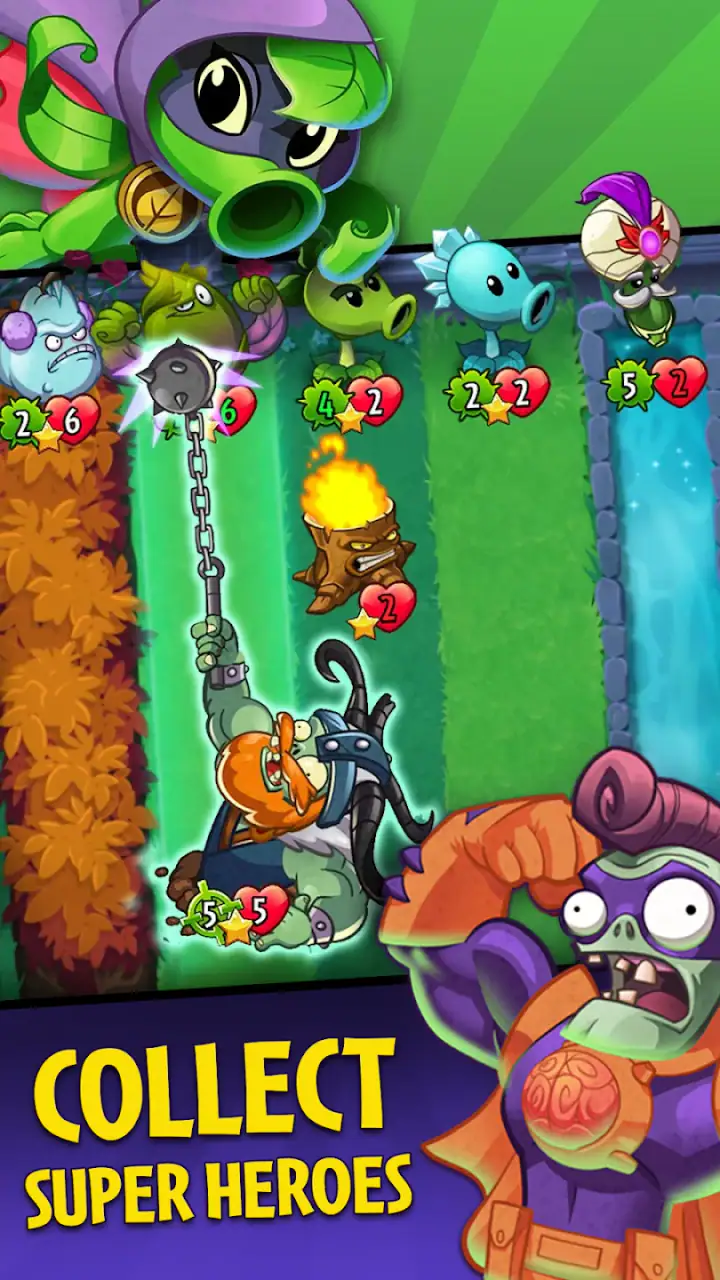
I particularly like how the game uses familiar faces to create an immediate emotional shortcut. A new player does not need a long explanation to understand why a strange plant or clumsy zombie belongs in this universe. That recognition helps the collection aspect feel personal rather than purely numerical. I am not only gathering anonymous units; I am building a roster from a world I already understand.
There is also a practical benefit to the setting. The humor gives the game room to present failure without making every defeat feel severe. When a match goes badly, the mood remains lighter than it would in a darker fantasy or military card game. That makes short sessions easier to return to, especially when I want something more engaging than a passive time-killer but less emotionally heavy than a competitive action game.
Art direction that supports reading the board
The illustrations are bold enough to stand apart from one another, which matters when a match becomes busy. The characters have strong silhouettes and exaggerated expressions, so I can scan the board without feeling that every card is visually interchangeable. This is one of the game’s quiet strengths: the art is loud in personality but generally clear in purpose.
That clarity does not remove the need to read. A funny animation or dramatic effect can still pull my attention away from the board, and new cards may require a moment of study before their role becomes obvious. I learned to slow down when trying an unfamiliar deck instead of relying on the artwork to tell me what to do. The visual design helps me orient myself, but it cannot replace understanding card interactions.
For younger players and families, the Everyone rating fits the welcoming presentation. For adults, the style is still enjoyable if they appreciate cartoon comedy, although anyone expecting a darker or more strategically austere card game may find the constant cheerfulness too lightweight. The art is not trying to be realistic, and the game is better when approached on those terms.
Sound and rhythm make short matches feel lively
The audio presentation follows the same rule as the artwork: it keeps the conflict playful. Character reactions, card actions, and match feedback help each turn feel like an event rather than a silent calculation. I do not need to watch every animation closely to understand that something important happened, because the sound and movement usually provide a clear response.
That feedback is especially useful on a small screen. When I am playing in a quick break, I may not be staring at the board continuously. Distinctive effects help me notice that a card has activated, a lane has changed, or a turn has advanced. The result is a rhythm that feels more energetic than a static tabletop simulation.
At the same time, the lively presentation can make the game feel faster than it really is. A sequence of effects may suggest constant action even when the deeper decision is simply whether to preserve a card for a later turn. I found that the best way to enjoy the pacing is to separate the entertainment layer from the strategic layer: let the animations be fun, but do not let them rush my choices.
This is where the game works well as a mobile experience. A match can provide a complete little burst of play, with a clear beginning, a series of escalating decisions, and a finish that does not require a long uninterrupted evening. If I am waiting for an appointment, I can play a round; if I have more time, I can continue experimenting with a different hero or deck direction.
How the card mechanics fit the world
The card format suits the Plants vs. Zombies theme because both sides are built around recognizable characters with specific jobs. A plant or zombie is not just a generic token; it carries a visual identity that makes the board feel like a miniature episode from the series. The heroes add another layer by giving the deck a clear personality before I even draw my opening hand.
In practice, I found that the most satisfying decisions happen before the attack animation. Building a deck forces me to decide what kind of match I want to create. Do I want a straightforward plan that establishes pressure early, or a more patient arrangement that depends on surviving long enough for stronger combinations? The game is most interesting when the deck has a coherent idea rather than a pile of cards I happen to like.
One non-obvious lesson is that collecting more cards does not automatically solve a weak deck. New options can make decision-making harder if they pull the strategy in different directions. I became more successful when I treated each addition as a question: does this card support the hero and the rest of the deck, or am I including it only because it looks powerful on its own?
Another useful habit is to watch the shape of a match rather than focusing only on individual victories. A card that seems unimpressive in isolation may be valuable because it stabilizes an awkward turn, protects a developing plan, or gives the deck a better sequence of plays. This is the kind of insight that is easy to miss when the game is approached as a simple character-collection exercise.
Deck building is rewarding, but the collection layer needs patience
The collection system gives the game a reason to remain installed after the novelty of the first matches fades. I enjoy opening up new possibilities and revisiting a deck after learning more about its strengths. The process feels especially good when I discover that a card I previously ignored fits a strategy I now understand.
However, the long-term experience can feel less even than the first hours. Players who want immediate access to every option may become frustrated by the gap between having an idea for a deck and having all the pieces needed to test it. The game is free, but its in-app purchases range from $0.99 to $99.99 per item, so anyone sensitive to collection-driven spending should decide on a personal limit before getting deeply involved.
My advice is to avoid treating every new card as a reason to rebuild everything. Choose one or two deck ideas, learn their basic rhythm, and improve them gradually. This approach makes the collection feel like a source of discovery instead of a checklist. It also reduces the temptation to spend simply because a new possibility appears before the current deck has been properly tested.
That trade-off is central to deciding whether the game is right for you. If you enjoy slowly refining a collection and finding clever uses for imperfect tools, the progression can be motivating. If you want a fully open competitive environment immediately, a traditional card game with a simpler unlock model may suit you better.
A realistic everyday use case
I can imagine using this game during a commute or a short lunch break, but with one qualification: I would start a match only when I had enough uninterrupted time to finish it comfortably. The opening turns may feel relaxed, yet a close battle can demand concentration near the end. It is a better fit for a planned ten-minute pause than for a moment when I might need to put the phone away without warning.
For a parent and child, the accessible characters could make the first conversation about card games easier. The child can talk about favorite plants or zombies, while the adult can gradually introduce ideas such as saving a card, reading the opponent’s likely plan, and building a balanced deck. The Everyone rating supports that approachable presentation, though an adult should still explain that optional purchases exist before handing over a device.
For a more experienced card-game player, the everyday use case is different. This is a lighter alternative for when I want familiar strategic patterns without committing to a grim setting or a highly formal presentation. I would not choose it as my only competitive card game, but I would choose it when the mood matters as much as the mechanics.
Where it differs from other card games
Compared with a conventional fantasy collectible card game, this title is more immediately readable because its characters and conflicts come from an established cartoon world. It does not need to spend much time convincing me why a plant and a zombie belong on opposite sides. That makes the first session more inviting than many card games that begin with dense lore and unfamiliar terminology.
Compared with a simple solitaire or traditional card app, it offers far more personality and long-term experimentation. The opponent, hero choice, deck construction, and board decisions give each match a stronger sense of direction. The cost is that I cannot treat it as a purely passive distraction; even a short game asks me to follow what is happening.
Compared with a fast action game, it is calmer and more deliberate. I am not testing reflexes or aiming under pressure. That makes it a better choice for players who enjoy planning, but a poor substitute for someone who wants direct control and immediate physical excitement. The animations create energy, yet the core pleasure still comes from anticipating the next exchange.
Its most distinctive position is between a family-friendly character game and a genuine deck-building challenge. The bright presentation may attract players who would normally avoid card games, while the underlying decisions can keep more experienced players interested. The balance is not perfect, but it is specific enough to give the game its own identity.
Limitations that become clearer over time
The biggest limitation is not the basic card play; it is the possibility of friction around progression. A new player may understand the match rules quickly but still need considerable time to understand which cards deserve a place in a reliable deck. That learning curve is manageable, though it can feel opaque when a loss seems to come from collection quality rather than a clearly visible mistake.
The presentation can also hide important strategic information behind its enthusiasm. When several effects happen in sequence, I have to resist the urge to tap through them automatically. Players who prefer a quiet, highly transparent interface may find the comic energy distracting, particularly when they are trying to analyze why a turn went wrong.
There is also a difference between enjoying the theme and enjoying repeated competitive play. The characters remain charming, but charm alone cannot carry a weak strategy forever. After the initial discovery period, the game asks me to engage with deck structure, resource timing, and matchup awareness. Anyone who wants only a casual character showcase may prefer a less demanding Plants vs. Zombies experience.
The current version is 1.64.6, and the game’s long history since its release on October 17, 2016, is visible in the amount of content and accumulated systems. That maturity is useful for players who want an established card game, but it can also make the experience feel more layered than a newcomer expects. I recommend giving the tutorial and early matches time rather than judging the full game from the first screen.
Who should install it, and who should skip it
I would recommend it to fans of the Plants vs. Zombies characters who are willing to meet them in a slower, more tactical format. It is also a strong choice for someone curious about collectible card games but put off by gloomy art, complicated fantasy lore, or an overly serious competitive atmosphere. The free entry point makes it easy to sample, and the broad device support helps older Android users get started.
I would be more cautious recommending it to players who dislike collection-based progression or who want every strategic option available from the beginning. The in-app purchase range means spending discipline matters, especially for younger users. I would also steer away players who need a game that can be abandoned instantly at any point; a close match deserves attention through its final turns.
If your priority is relaxing with recognizable characters, the art and sound do a lot of work. If your priority is mastering a deep card system, the game can still provide that, but you will need to look past the jokes and study how your deck actually functions. The best audience sits in the middle: people who want strategy delivered with a generous amount of personality.
The atmosphere holds together because every layer serves the same mood
What impressed me most is the consistency between the setting, the illustrations, the sound, and the pacing. Nothing feels as though it belongs to a completely different game. The playful characters make the cards approachable, the audio gives turns a lively pulse, and the board decisions add enough weight to keep the experience from becoming empty decoration.
That coherence also explains why the game remains inviting after the first impression. I can enjoy the humor casually, but I can also switch into a more analytical mindset when a deck needs work. The mood does not disappear when the strategy becomes serious; instead, the comedy makes the concentration feel less exhausting.
My final view is positive, with clear reservations. Plants vs. Zombies™ Heroes is at its best when you want a colorful card battler that respects your brain without taking itself too seriously. It is not the right choice for instant access to a complete collection, completely frictionless progression, or action-game intensity. But for short strategic sessions, character-driven deck building, and a world where plants and zombies can turn a tactical mistake into a joke, it remains an unusually well-matched package.
Since it is free to start and carries an Everyone rating, I think it is worth trying if the combination of cartoon atmosphere and card strategy appeals to you. I would begin without spending, focus on learning one dependable deck, and pay attention to how the board develops rather than chasing every new card. That approach lets the strongest part of the game come through: the pleasure of making a clever decision inside a world that never forgets to smile.
FAQs for Plants vs. Zombies™ Heroes
What is Plants vs. Zombies™ Heroes about?
Plants vs. Zombies™ Heroes is a strategic card battle game where players collect and choose hero characters, both plant and zombie, to build decks. The goal is to engage in battles using unique abilities and strategies to defeat opponents. It combines elements of collectible card games with the iconic Plants vs. Zombies universe.
Is Plants vs. Zombies™ Heroes free to play?
Yes, Plants vs. Zombies™ Heroes is free to download and play. However, it offers in-app purchases that allow players to buy card packs, coins, and other items that can enhance gameplay. While not necessary to progress, these purchases can speed up player advancement and provide cosmetic enhancements.
What are the main features of Plants vs. Zombies™ Heroes?
The game features over 20 unique plant and zombie heroes, each with their own special abilities. Players collect hundreds of cards to build their decks, engaging in both single-player adventures and multiplayer battles. The game also includes daily challenges and events that offer rewards and keep the gameplay fresh and engaging.
Does Plants vs. Zombies™ Heroes require an internet connection?
Yes, an internet connection is required to play Plants vs. Zombies™ Heroes. Online connectivity is necessary to access multiplayer features, download updates, and participate in daily challenges and events. Players should ensure a stable connection for an optimal gaming experience.
Can I play Plants vs. Zombies™ Heroes on multiple devices?
Yes, you can play on multiple devices by linking the game to your EA account or through social media accounts like Facebook. This allows you to sync your progress and continue playing seamlessly across different devices. Ensure you are logged in on each device to access your saved data.
Pros
- Engaging card battle mechanics.
- Variety of heroes to choose from.
- Colorful and vibrant graphics.
- Strategic gameplay depth.
- Frequent updates and events.
Cons
- In-app purchases can be pricey.
- Requires stable internet connection.
- Some characters feel overpowered.
- Occasional loading delays.
- Tutorial might feel lengthy to some.


